
The easiest way to design an AI course is to organise it around tools. One session on chatbots, one on image generators, perhaps a prompt template with enough boxes to look official.
It is also a good way to create a course that feels dated before the final slide deck is translated.
When the Future Designers partners met in Matosinhos, Portugal, on 25 and 26 June 2026, we chose a different anchor. The project will focus on a durable human capability: creative agency.
Our mission is to help build a young generation with the power to make and the authority to decide.
That sentence became the centre of the Learning Outcomes Framework for the GenAI Starter Kit and the "Design with GenAI" Teacher Bootcamp. It also gave us a simple test for every activity we develop: does this help children direct the creative process, or does it make the machine the de facto author?
A transformation we can design for
The workshop brought together representatives from Designathon Works, Asociación Comunidad de Aprendizaje Activo, Change of Course and Scholé. We worked on the direction of the Starter Kit, the teacher bootcamp and the learning outcomes that connect them.
The student transformation we agreed on is blunt:
From "AI, do it for me" to "I made this, and I made the calls."
A Future Designer should bring an idea before asking AI for one. They should be able to steer the machine, question what it returns, select what deserves to survive and own the final decision. They should also consider who benefits, who may be missing and what the use of AI costs.
The teacher transformation is just as important:
From cautious AI user to guarantor of children’s creative agency.
Teachers do not need to become miniature machine-learning engineers. They need enough understanding and confidence to run a creative, critical design process in which children remain responsible for their work. Sometimes that means using AI. Sometimes good teaching will mean closing the chatbot and reaching for paper.
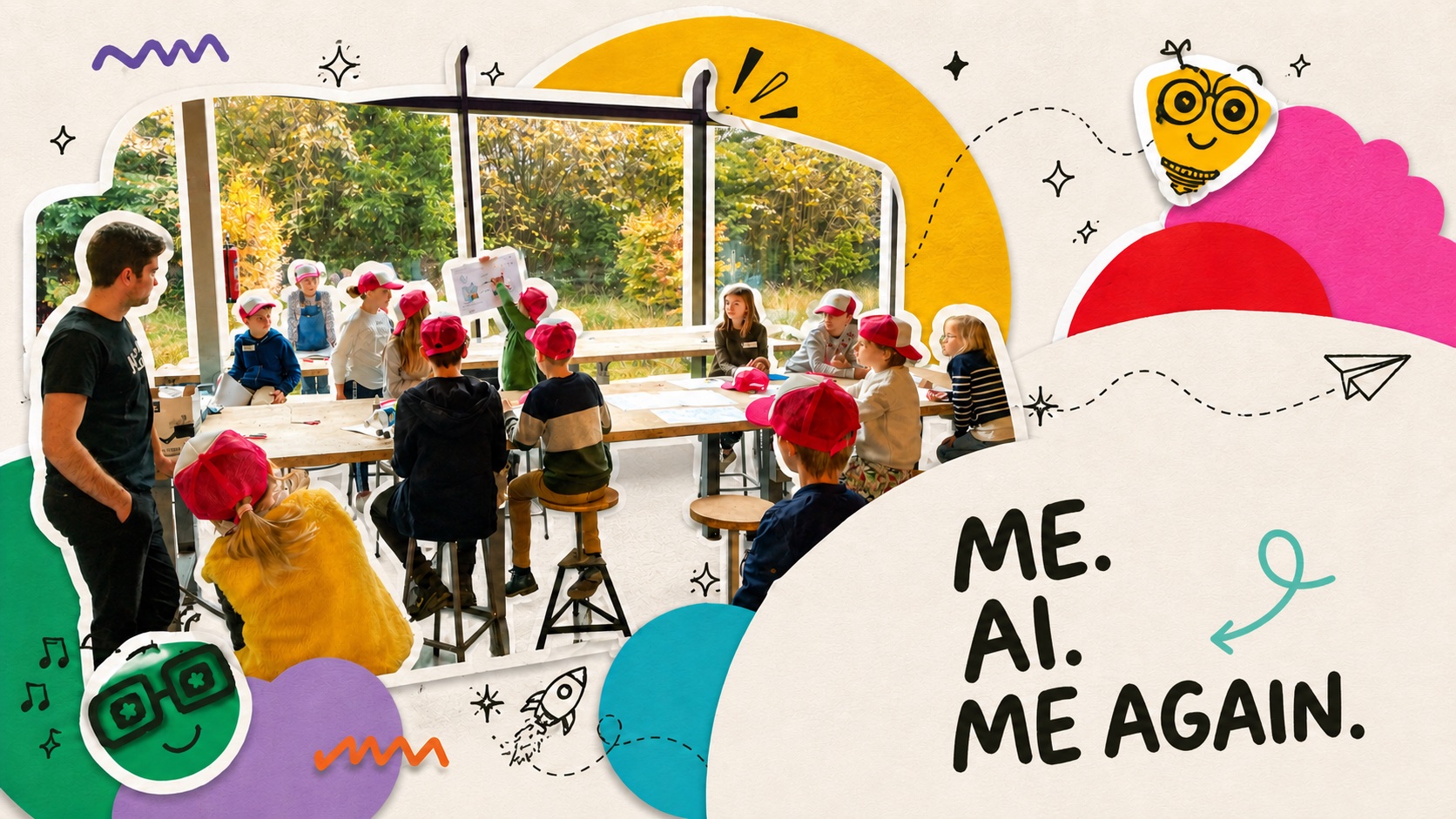
The Me → AI → Me loop
The workshop condensed this direction into a repeatable classroom loop:
First me. The child starts with an idea, sketch, question or point of view before consulting AI.
Then AI. The child asks for support and directs the tool across several rounds. They check its claims, compare alternatives and look for errors, missing needs and bias.
Then me again. The child chooses what to accept, reject or change. They refine the work, make the final call and explain their decision.
This sequence matters because the order changes the learning. If AI goes first, its output becomes the frame. Children may edit the machine’s idea without noticing that they never formed their own. Starting with the child creates something to compare. Ending with the child returns responsibility to the right place.
The loop is not a ritual to perform once at the beginning of a lesson. It should shape research, ideation, prototyping, feedback and reflection. Questions about fairness, truth, privacy and environmental impact run underneath every step.
What we prioritised
We used the SKAV framework to describe the skills, knowledge, attitudes and values that the Starter Kit and Bootcamp should develop. The framework marks several leading priorities, subject to final consortium validation, and they tell the story.
For children using the Starter Kit, critical checking comes first among the skills. An AI answer should be treated as a claim to test: does it make sense, what does another source say, and what may be invented or unfair?
The central knowledge outcome is equally unglamorous and useful. Children should understand that GenAI predicts likely words or pixels from patterns in human-made data. It does not "know" in the way a person knows. That basic idea makes healthy scepticism easier to teach.
The priority attitude is agency in child-friendly language: "I stay the boss." AI may help, but the child keeps the final decision. The corresponding value is honesty and authorship. Pupils should be able to show what came from them, what came from AI and what they changed.
For teachers, the first skill is explaining GenAI simply to children aged 9 to 12. The priority attitude is confidence to facilitate without pretending to know everything. The leading value is putting student agency and ownership first.
In the more advanced Bootcamp, teachers will learn to design and facilitate a full AI-supported project, not bolt a chatbot onto an existing lesson. They will explore when AI deepens learning and when it merely makes the output shinier. The core commitment is to prevent overreliance and preserve human judgement.
These priorities give us something more useful than a catalogue of competencies. They describe the behaviour we want to see in a classroom.
From framework to classroom material
The Starter Kit will turn the loop into low-preparation activities, examples, templates and reflection prompts. It must work in ordinary school conditions, including limited devices, mixed levels of digital confidence and classes where pupils should not create personal accounts.
Low-tech options are part of the design, not an apology at the back of the guide. A teacher might project one AI response and let the class investigate it together. Pupils can practise comparing, choosing and explaining without each child sitting behind a screen.
The Bootcamp will help teachers experience the same process themselves. They will test use cases across design and project-based learning, adapt activities for their own classes and return with evidence about what happened. Teacher cards, student worksheets, prompt cards and assessment tools will make the learning visible.
The consortium also agreed to collect evidence during activities rather than chase participants afterwards. Reflection and evaluation belong inside the training. This is more reliable and kinder to everyone’s inbox.
A mission sturdy enough to survive the next model release
AI tools will keep changing. Some will disappear. Others will acquire another button that promises to do the thinking for us.
Our educational mission should be more stable than the software.
Future Designers is building for children who can create with AI without becoming passive consumers of its output. They can form intentions, ask better questions, test what they receive and decide what deserves their name.
First me, then AI, then me again.
It is a small loop with a large job: keep the child on both sides of the machine.
Read the Future Designers Learning Outcomes Framework and follow the project as we translate it into the Starter Kit and teacher training.
Sources
- Future Designers TPM / Workshop 3.1 meeting notes, 25 and 26 June 2026.
- Future Designers Learning Outcomes Framework.