
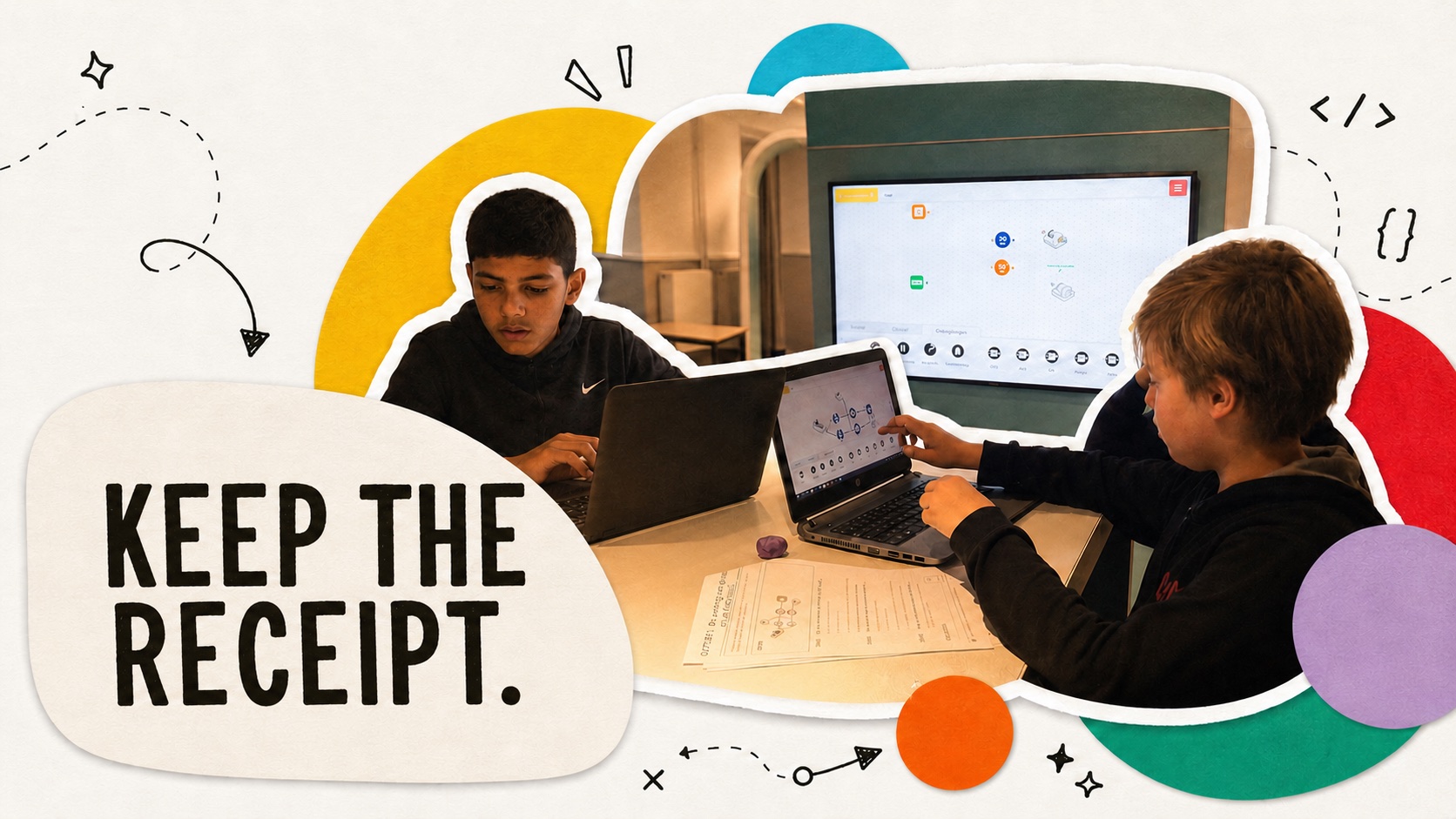
The final poster looks excellent. The argument is tidy. The illustration has the correct number of fingers, which already puts it above average.
Now the awkward question: what did the pupil actually do?
Teachers used to read the finished object as rough evidence of the work behind it. A paragraph carried traces of vocabulary, planning and revision. A cardboard model exposed its own wonky decisions. Generative AI weakens that connection. A polished result can now hide a thin process, while a clumsy result can hide excellent judgement.
Trying to solve this with AI detection is a dead end. The more useful move is to ask pupils for a small record of the choices that shaped the work.
Call it a creative receipt.
A receipt, not a confession
The name is deliberate. A shop receipt tells you what went into a transaction. It does not accuse the customer of stealing the groceries.
A creative receipt does the same for an AI-supported project. It records where the pupil began, what help they requested, what they refused, what they changed and what they are prepared to call their own.
This should not become a surveillance log with twelve screenshots and a complete prompt history. Primary pupils do not need more paperwork, and teachers certainly do not need another archive to inspect. Five short questions are enough:
- What were you trying to make or solve?
- What did you ask AI to help with?
- What did AI suggest that you did not use?
- What did you change after seeing the output?
- Which final decision is yours, and why?
Answers can be written, recorded as audio, discussed with a partner or captured with a quick drawing. The format should fit the child and the task.
Why the rejected idea matters
Most classroom evidence celebrates what survives. The discarded material often tells us more.
Suppose a group asks an image generator for a poster about saving water. The system produces a polished image of a child brushing their teeth beside a running tap. The group rejects it because the image contradicts the message. They replace it with their own photo of a closed tap and add a line about collecting rainwater.
The first image does not appear in the final poster. Without the receipt, the teacher may never see the pupils spot the contradiction. Yet that rejection is exactly where critical judgement happened.
The same principle appears in a Klasse account of AI-supported writing lessons. Pupils evaluated AI text with a rubric, then received marks for their arguments and changes rather than the generated text itself. The focus moved from the clean final product to the thinking done in class.
That is a much better place to look.
The receipt changes the assignment
Once pupils know they will explain a rejection and a revision, AI use becomes less about obtaining a fast answer. They have to keep watching themselves work.
The teacher can also assess more honestly:
- Did the pupil begin with an intention?
- Could they notice when the output did not fit?
- Did they make a meaningful change?
- Can they explain a decision in their own words?
These questions do not reward the pupil who typed the longest prompt. Prompt length is not evidence of agency. A child can paste a magnificent instruction written by an adult and learn very little. Another child can use one simple request, reject most of the answer and make a smart final choice.
The creative receipt gives that second child somewhere to show the work.
A classroom example
Imagine a design challenge: create a simple way to help new pupils feel welcome during their first week at school.
One group sketches a "welcome trail" with signs around the building. They ask AI for ten ideas that could go on each sign. The suggestions include a school map, a list of rules, jokes, staff portraits and a QR code linked to a video.
Their receipt might read:
Our intention: Help a new pupil find places and people without feeling embarrassed.
AI help: We asked for ideas for the signs.
What we rejected: A long list of school rules. It felt like a warning, not a welcome.
What we changed: We replaced staff portraits with drawings made by pupils and added a quiet-place symbol.
Our decision: The trail starts at the toilets, because that is something a new pupil may need but may not want to ask about.
That final decision is specific, humane and entirely absent from the generic AI list. It shows that the group understood the person they were designing for.
Keep privacy out of the paperwork
A receipt should not collect personal data merely to prove that no rules were broken.
Do not ask pupils to paste complete chat histories if those chats may include names, private experiences or other identifying information. Do not require screenshots that expose account details. Ask for a short description of the AI help instead.
Kennisnet's guidance for school agreements recommends transparency about AI use, continued human control and careful treatment of personal information. The receipt supports all three, provided it stays focused on decisions rather than data collection.
It also helps teachers discuss responsibility without pretending that "human in the loop" solves everything. A person can click approve without exercising judgement. The receipt asks what the person noticed and changed.
Do not grade honesty into extinction
There is one obvious risk. If pupils think every mention of AI will cost them marks, the receipts will become works of fiction.
Set the rule before the project begins: appropriate AI use is not the offence. Hidden substitution is the problem. A pupil should be able to write, "AI gave us this idea and we kept it because..." without being punished for telling the truth.
Grade the quality of the explanation in relation to the learning goal. If the task is about persuasive writing, look for choices about evidence, audience and wording. If it is a design challenge, look for attention to the user, constraints, testing and revision.
Some work should still happen without AI. A receipt is not permission to automate every task. It is useful when AI use is allowed and the teacher needs the learning process to remain visible.
Try it on one project
The creative receipt is a prototype, not a validated assessment instrument. Future Designers will need to test the wording, accessibility and workload with teachers and children aged 9 to 12.
That is a reason to keep it small.
Add the five questions to one design or writing task. Let pupils answer in five minutes. Then compare the receipts with the final work. Which important decision would otherwise have disappeared?
Keep that question. It is worth more than any AI detector score.
Sources
- Kennisnet, School agreements on the use of generative AI.
- Klasse, Smart language development with AI.
- Klasse, Computational thinking: especially in the age of AI.
- Kennisnet, Ethical dilemmas and AI in education.